Cameras designed for capturing black holes are now exploring a new frontier: they are helping us to get up close to viruses on Earth, opening the door to solving medical problems.
These space cameras are opening new frontiers in life sciences by probing ultrafast physical, chemical and biochemical processes at the atomic level, gaining clearer images of structures such as viruses and proteins.
A descendant of the X-ray space camera took the first images of the Mimi virus, the largest and most complex virus currently known. Analysis of this intriguing virus may shed light on basic questions of viral evolution and, perhaps, the origins of life.
Spin-off from space programme
Researchers at the University of Leicester in the UK developed special X-ray cameras for ESAs XMM-Newton satellite in the early 1990s.
"ESA funded a lot of that early work to create the X-ray sensors,” said Karen Holland, CEO of XCAM, the company founded in 1995 as a spin-off from the university to develop and market these advanced techniques.
Complex technology is required to take snapshots of the Universes X-rays, which are generated by extremely hot objects or from strong magnetic or gravitational fields.
"Things like black holes are what youre looking for, really, with this technique,” notes Karen.
"In order to capture an image in space, you often need many detectors, so the mechanical camera head on a satellites X-ray telescope is a very complicated item. It needs to hold and handle the detectors in an array, but must also be lightweight.
"All must be built so the area around the detector stays extremely clean, and all must function in space vacuum." Special electronics are also required to drive and operate the detectors.
Space technology spots Mimi virus on Earth
Once these technologies were developed for XMM-Newtons X-ray camera, the developers realised that the knowhow could be used in a variety of applications on Earth.
In addition to efficient mechanical cameras, XCAM also developed a new type of X-ray camera that produced better images for terrestrial applications, with smaller pixels at higher resolution.
As a result, XCAM was able to supply cameras for the X-ray Free Electron Laser at the DESY German Electron Synchrotron centre in Hamburg, Germany, to take very precise pictures of viruses. Understanding the virus structure could lead to better medicines and healthier people.
"Its the worlds first laser X-ray,” said Karen. "They were building it, and they realised they needed a camera.”
Thanks to XCAMs decades of experience, "We were able to design and build a camera system for them which took the first images of the Mimi virus.”
XCAM also developed a new detector design concept now being used at a similar facility in Japan.
XMM-Newton technology was the right solution
"The advanced research and development which were done for the XMM-Newton camera put XCAM in the position to acquire new business areas, initially for the advanced DESY research facility, and later also for the similar X-ray laser in Japan,” said Matthew Edwards from STFC Innovations, a broker in the Technology Transfer Network of ESAs Technology Transfer Programme Office.
"It is a great example of the potential of European leading-edge space technologies. They help our companies do better business, both the ones working in space programmes and spinning-off their space products and expertise directly as XCAM did, but also non-space companies which can profit from space technologies already developed and ready to be used in non-space sectors.”
Other potential applications include industrial uses like medical X-rays or X-ray microscopy. But for now, life sciences research, like that being done on the viruses, seems most promising.
"In the case of DESY, they wanted it very quickly,” said Karen. "We could give it to them, thanks to years of experience from our XMM-Newton development.”
ESAs Technology Transfer Programme Office with its Technology Transfer Network of technology brokers has helped to spin off technologies and expertise from ESA and European space programmes to non-space industries and systems.
More than 280 space technologies are now used in non-space applications as diverse as train tracking systems, ground-penetrating radar to detect cracks in mine tunnels and healthcare innovations.
To support the spin off and to foster new European business, seven Business Incubation Centres have been set up throughout Europe, supporting more than 60 start-ups every year.
Related links
Technology Transfer Programme Office
www.esa.int/Our_Activities/Technology/TTP2
Business Incubation
www.esa.int/Our_Activities/Technology/Business_Incubation
Technology Transfer Network
www.esa.int/Our_Activities/Technology/TTP2/Technology_Transfer_Network3
STFC
www.stfc.ac.uk/
XCAM
www.xcam.co.uk/
DESY
www.desy.de/
FLASH (pdf)
flash.desy.de/sites/site_vuvfel/content/e395/e2188/FLASH-Broschrefrs_web.pdf
XMM-Newton
www.esa.int/Our_Activities/Space_Science/XMM-Newton_overview
Stories from XMM-Newton
esatv.esa.int/Videos/2005/05/Stories_from_XMM-English
Ultimi Articoli

Domenico Formichetti porta CASA BLASTER alla Milano Design Week 2026

Benji & Fede tornano il 24 aprile con Oh, Maria! — a ottobre il debutto nei teatri italiani

Polignano a Mare — Si chiude la tre giorni dedicata a Domenico Modugno, tra bande, cinema e memoria condivisa
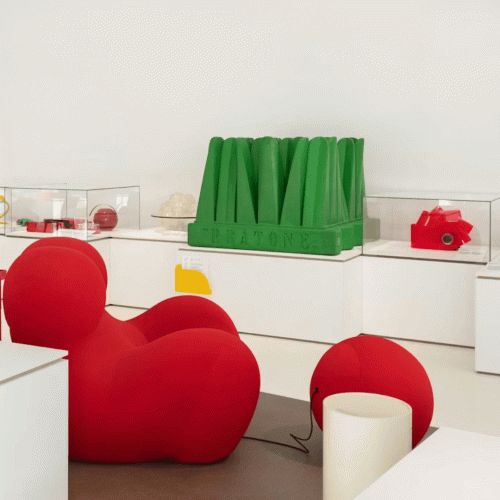
Triennale Milano apre mostre e incontri per la Milano Design Week 2026

Milano — “Gente di facili costumi” al Manzoni, ritmo vivo e dialoghi che tengono la scena

Triennale Milano apre la Design Week con mostre, incontri e laboratori

GENTE DI FACILI COSTUMI al Teatro Manzoni di Milano

Milano: George Foreman, la sua storia arriva in libreria con DIO AL MIO ANGOLO

Arisa torna con Foto Mosse — il nuovo album esce il 17 aprile