A close friend and a client of mine sent me this photo today, as captured by NASA, of a 'rare' cosmic event that happens every 3000 years. I wanted to share it with you for two reasons. One, on the lighter side of things, rumoured to be beneficial for making wishes; two, it really gave me a good reason to take a short break from work, and look up to the sky. I hope you would too. 'This photo is a very rare one, taken, by NASA, with the hubble telescope. It's called "The Eye of God". I've been told that this kind of event occurs once in 3000 years.
Had enough chain mails for today with promises to make your wishes come true. So I'll spare you the one accompanying this photo. But hey !! Do what you wish with it and good luck !!' - Ritu
I was fascinated by this picture, forgot to make a wish, and went immediately instead to Google to search for more info about it. As it turned out, this image was captured, or published, on May 10 2003 and has captured people?s imagination since. However, since there ?are no coincidences, this image lead me to ? Discover the cosmos! where each day a different image or photograph of our fascinating universe is featured, along with a brief explanation written by a professional astronomer. Just in case, as you look at the 'Eye of God', do make your wishes; then read the science bit explaining what it is known as, NGC 7293- The Helix Nebula:
Credit: NASA, WIYN, NOAO, ESA, Hubble Helix Nebula Team, M. Meixner (STScI), & T. A. Rector (NRAO) Explanation: Will our Sun look like this one day? The Helix Nebula is the closest example of a planetary nebula created at the end of the life of a Sun-like star. The outer gasses of the star expelled into space appear from our vantage point as if we are looking down a helix. The remnant central stellar core, destined to become a white dwarf star, glows in light so energetic it causes the previously expelled gas to fluoresce. The Helix Nebula, given a technical designation of NGC 7293, lies about 650 light-years away towards the constellation of Aquarius and spans about 2.5 light-years. The above picture is a composite of newly released images from the ACS instrument on the Hubble Space Telescope and wide-angle images from the Mosaic Camera on the WIYN0.9-m Telescope at Kitt Peak National Observatory. A close-up of the inner edge of the Helix Nebula shows complex gas knots of unknown origin.
The other fascinating picture the eye of God lead me to, is that ofMyCn18: An Hourglass Nebula, posted on January 18, 1996:
Credit: R. Sahai and J. Trauger (JPL), WFPC2 Science Team, NASA
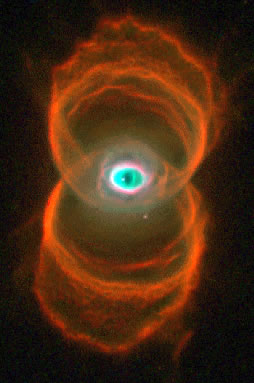 |
Explanation: The sands of time are running out for the central star of this hourglass-shaped planetary nebula. With its nuclear fuel exhausted, this brief, spectacular, closing phase of a Sun-like star's life occurs as its outer layers are ejected - its core becoming a cooling, fading White Dwarf. Astronomers have recently used the Hubble Space Telescope (HST) to make a series of images of planetary nebulae, including the one above. Here, delicate rings of colorful glowing gas (nitrogen-red, hydrogen-green, and oxygen-blue) outline the tenuous walls of the "hourglass". The unprecedented sharpness of the HST images has revealed surprising details of the nebula ejection process and may help resolve the outstanding mystery of the variety of complex shapes and symmetries of planetary nebulae.
MORE: www.psychicsahar.com